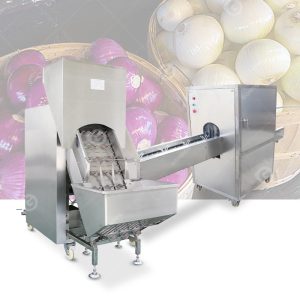
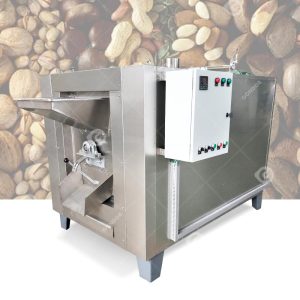
How a Sri Lankan Fruit Pulp Plant Evaluated a Multi-Line Fruit Peeling Solution
A process engineer from Sri Lanka contacted us in mid-2026 while designing a frozen fruit pulp plant from the ground up. The project is a first for the local market: fresh pulp, no additives, no preservatives, packed in 1 kg portions, quick-frozen to -20 °C and destined for export.
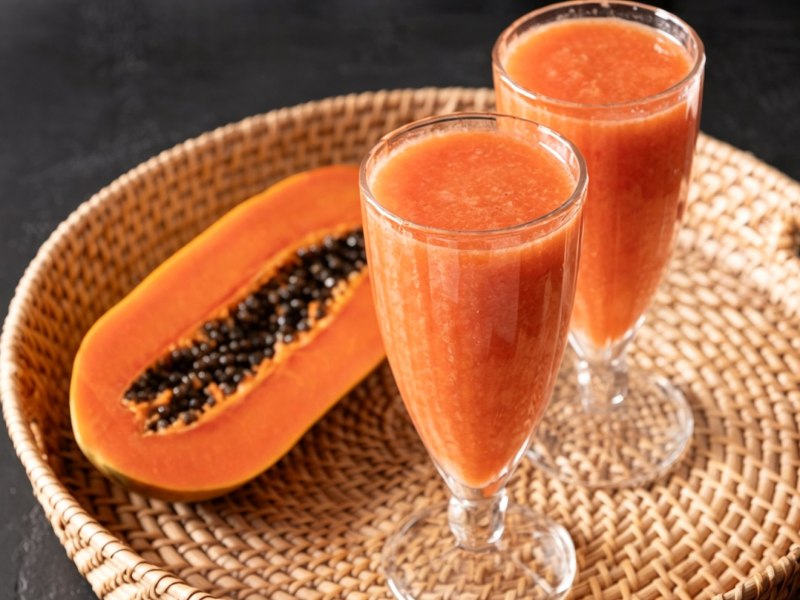
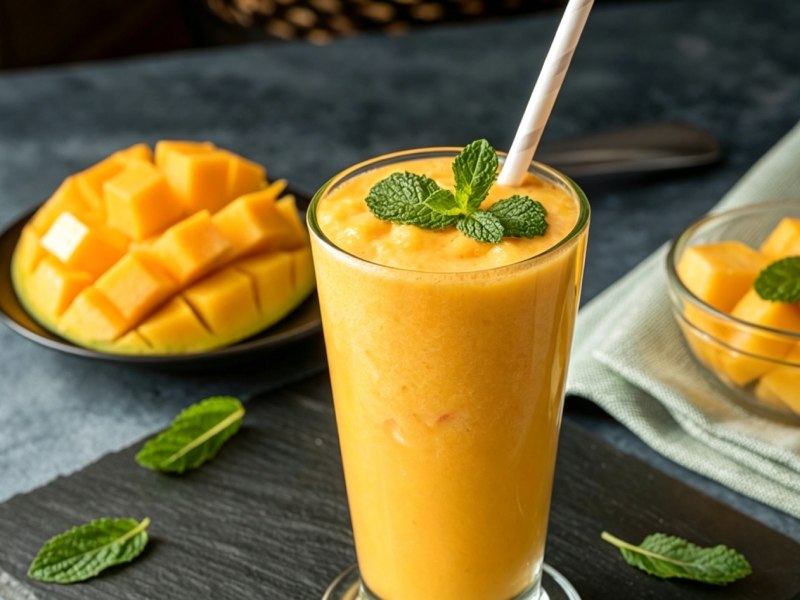
The pack house is built around four fruit lines – pineapple, papaya, mango and avocado – at a target of 500 kg/hr. Our task was to turn that brief into a working equipment layout: bubble washing, surface drying, peeling, and pulping with integrated sieving, arranged as semi-automatic lines that keep operators in the process.
We recommended four dedicated peeling machines, one per fruit, plus a pulper with a built-in sieve to separate seeds, eyes and fibres without hand contact. The project is in the consultation stage; our engineers are reviewing the customer’s specification sheets point by point before the final configuration is confirmed.
Customer Requirements
The customer is a process engineer spearheading the end-to-end design of a modern packhouse and processing facility. Rather than seeking a generic processing line, he outlined several non-negotiable requirements based on his facility’s layout, product specification and local employment regulations.
- First, production must take place within a strictly regulated cleanroom environment.
Raw materials arrive in stackable plastic crates (approximately 10 kg each) via chilled trucks and are held in four separate chiller rooms, one per fruit. From there, electric pallet trucks transfer the crates to conveyors, and the fruit enters the cleanroom through a small wall opening fitted with an active air curtain. Air must leak outward for bio-security. The product itself is uncompromising: fresh pulp, no additives, no preservatives, frozen without any heat treatment — because cooking alters the flavour of tropical fruit — packed in 1 kg portions and quick-frozen to -20 °C for export.
- Second, the facility requires four entirely separate processing lines.
Pineapple and papaya are available year-round in Sri Lanka, while mango and avocado are seasonal. Dedicated lines are essential to streamline operations and strictly eliminate any risk of cross-contamination — especially crucial for an unpasteurized product. Each fruit also has its own peeling and seed-handling requirements: pineapple must be peeled, cored and have its eyes removed “as far as practical”; papaya, mango and avocado all require seed handling, ideally without hand contact. After peeling, seeded fruits pass through a pulper with an integrated sieve so that seeds, leftover eyes and fibres are separated automatically, leaving a thick paste with no water added — only the fruit’s own juice.
- Third, the client faces a local regulatory constraint: the project must provide a certain number of jobs to gain approval.
A semi-automatic line with manual loading is therefore preferred over a fully automated system — machines handle the repetitive peeling and pulping, while operators feed fruit, inspect output and handle packing. Throughput is fixed at 500 kg/hr across all four lines. The machinery must also accommodate significant natural size variation in the raw materials without time-consuming pre-sorting, and the entire electrical system must be compatible with the local 230/400 V, 3-phase, 50 Hz standard. CIP cleaning is required every four hours of operation. The customer supplied his own specification sheets for the peeler and the bubble washer and asked us to confirm compliance with every item.
Challenges Identified
Five issues stood out, and each one shaped the solution.
- Cross-contamination between fruits.
A single multi-purpose peeler would be cheaper, but switching between fruits means cleaning cycles between products and a real risk of carryover. For a plant selling to export buyers under the highest international standards, that risk is not acceptable. Dedicated machines cost more, but they remove the problem at the design stage.
- Pineapple eyes versus flesh yield.
This was the customer’s sharpest point, put better than most buyers ever manage: if the machine cuts too deep, the best-flavoured outer layer goes into the bin. Fully automatic eye removal always costs flesh – no machine removes every eye with zero damage. The real decision is between a fast automatic pass with higher fruit loss and a lighter peel with a manual touch-up that preserves yield.
- Seed removal without hand contact.
Once the skin is off, the fruit is exposed, and every hand touch is a contamination risk in a clean room. Papaya seeds in particular cling to the flesh, so hand deseeding was ruled out by the customer himself – which pushed us toward the pulper with an integrated sieve.
- A new product category with no local benchmark.
Frozen fruit pulp for export is new to Sri Lanka, with no neighbouring plant to copy, so every machine has to be justified on paper – specifications, test videos, references – before purchase. The customer checked our track record directly, asking whether we had supplied a complete line of this kind anywhere.
- Seasonal raw material.
Pineapple and papaya run all year, but mango and avocado are seasonal. Machines on those lines sit idle part of the year, so the selection must balance utilisation against labour costs, and the machines must tolerate proper shutdown and storage between seasons.
Our Technical Recommendation
We proposed a line architecture rather than a single machine.
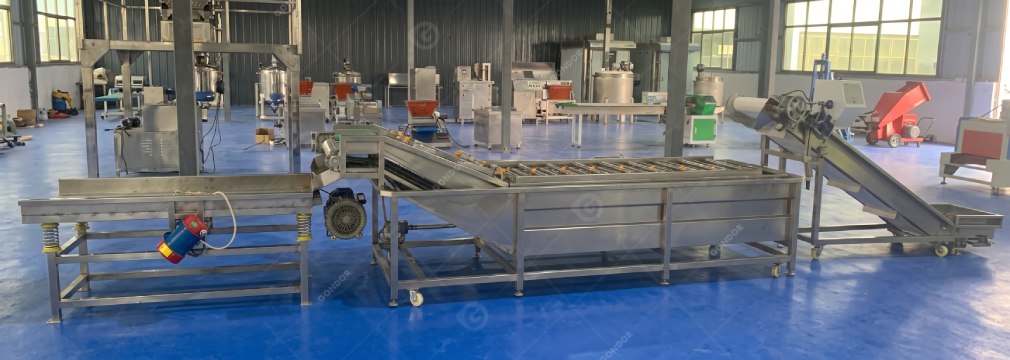
- Bubble cleaning machine with conveyor feed.
Fruit leaves the cold rooms and is washed to remove soil and surface residues. The washer length is selected by capacity – for 500 kg/hr we sized a unit with a matching conveyor section so crates can be tipped straight onto the belt. An air-blow drying section is integrated at the discharge end: freshly washed fruit carries a lot of surface water, which makes peeling messy and adds load downstream, so a short drying run removes surface moisture before the fruit reaches the peeler.
Dedicated peeling machines, one per fruit:
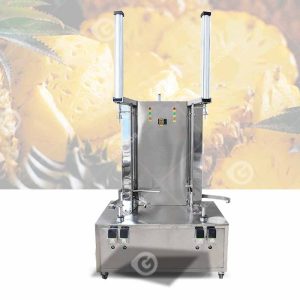
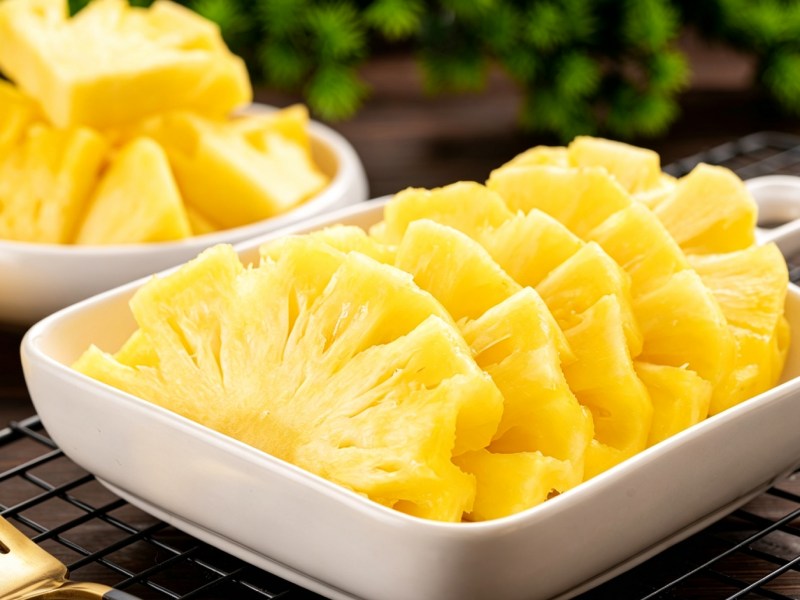
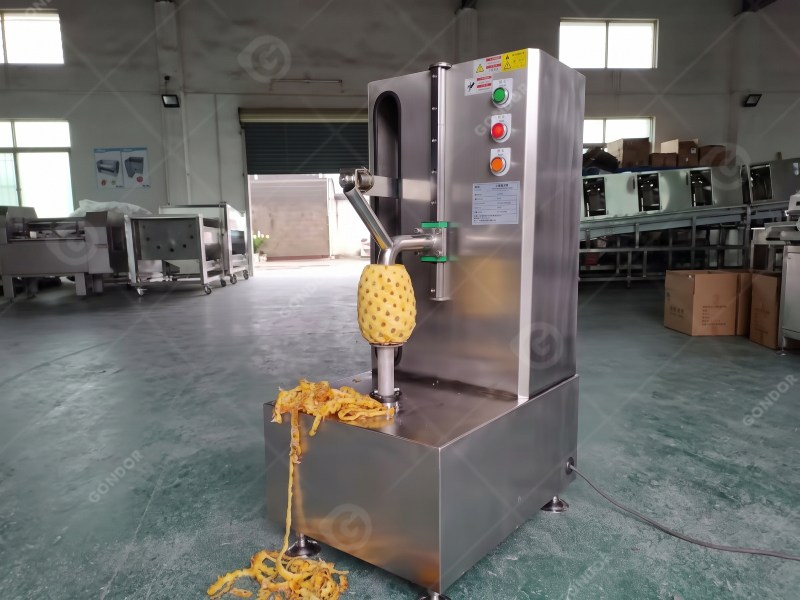
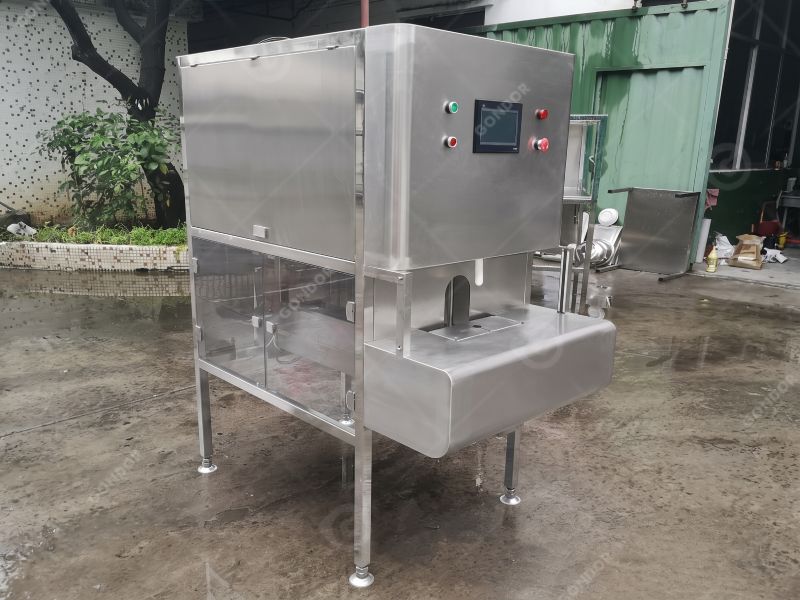
- Pineapple. A pineapple peeling and coring machine removes the outer skin and the central core. For the eyes we offered two options: a lighter single-layer peel plus a quick manual trim (minimal flesh loss, some labour), or a double-layer peel that removes the eyes automatically with higher yield loss. Given his emphasis on maximum yield, we recommended the first, with the pulper’s sieve catching remaining eye fragments.
- Papaya. A dedicated machine that peels and halves the fruit. Seeds are separated in the pulper, so no hand deseeding is needed.
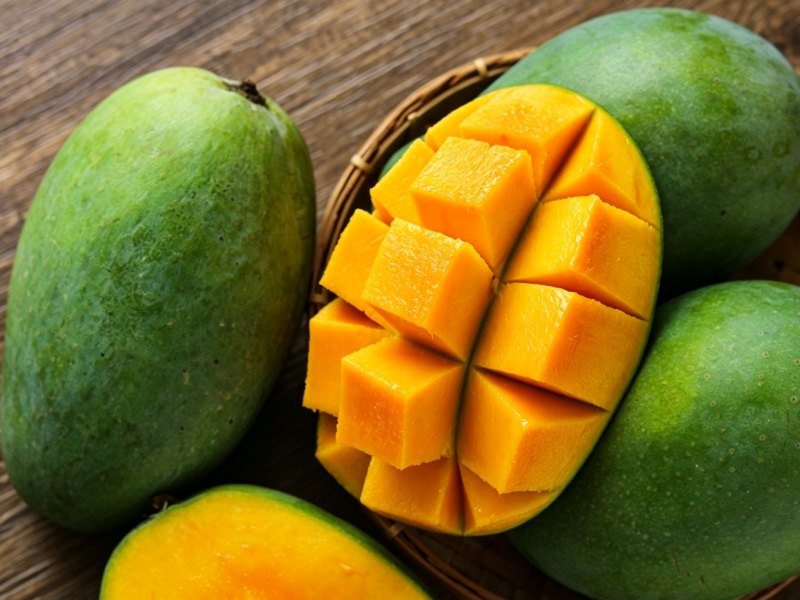
- Mango. A mango peeler machine with automatic size adaptation, demonstrated in a test video with large and small mangoes.
- Avocado. A separate dedicated machine that halves the fruit after peeling so the pit drops out on its own. It does not remove the pit; we confirmed this limitation up front.
- Pulper with integrated sieve.
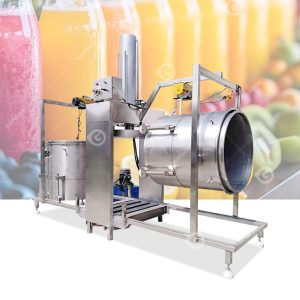
For papaya, mango and avocado, the peeled and halved fruit goes into a pulper that separates seeds, leftover eyes and fibres, producing a thick paste with no added water. The same machine doubles as a safety net for small pineapple eyes.
All machines adapt to fruit size automatically, suit clean-room operation, and use food-grade stainless steel on contact surfaces, configured to the customer’s 230/400 V, 50 Hz supply.
Equipment Solution
| Machine Name | Customized Tropical Fruit Preparation Line |
| Capacity | 500 kg/hr per dedicated product line |
| Power | 230/400V, 3 Phase, 50 Hz |
| Material | Premium SUS304 Food-Grade Stainless Steel (Optimized for CIP cleaning and acidic fruit resistance) |
| Automation | Semi-Automatic (Conveyor-fed from pallets; manual auxiliary loading to meet local employment mandates) |
| Optional Configuration | Customizable integrated sieving meshes (adjustable for different seed/eye dimensions), bespoke conveyor lengths for wall-opening integration. |
| Suitable Products | Pineapples, Papayas (Papaws), Mangoes, and Avocados (Seed separation handled post-peeling). |
Communication Highlights
The engagement began as a standard inquiry regarding pineapple peelers but rapidly evolved into a high-level plant engineering consultation. The client, possessing extensive process design experience, immediately provided standard technical specification sheets (Specs) for bubble washers and peeling tolerances, setting a highly professional tone.
A pivotal moment in the dialogue occurred when discussing the physical realities of fruit peeling. When our team transparently explained that no machine in the world can automatically remove 100% of deep pineapple eyes with zero flesh damage, we offered two standard industry options: double-layer peeling (higher waste) or single-layer peeling with manual trimming (lower waste).
Understanding the unique requirements of the unheated pulp process, the client rightly pointed out that manual trimming would introduce unacceptable contamination risks to the cleanroom. In rapid response, our team pivoted the strategy, leveraging our broader food processing expertise. We suggested bypassing manual trimming entirely by utilizing an integrated pulper-sieve down the line. This collaborative problem-solving approach—where the client defined the bio-security boundaries and our team supplied the mechanical workaround—solidified the technical trust between both parties.
Furthermore, the discussion smoothly integrated logistical realities, mapping out exactly how plastic crates would move from chillers to conveyors, ensuring our machinery footprints would match the client’s architectural blueprints perfectly.
Industry Insights
Conclusion
The project is still in the consultation stage. The customer is evaluating the machine set against his own specification sheets, and we are confirming the remaining details – pulper configuration, videos, final line layout – before quotation.
He is a demanding client in the best sense: precise, informed, and clear about what he wants. We will keep the discussion moving at his pace until every point on his sheets is answered. If your plant faces similar questions – peeling yield, seed handling, clean-room requirements – we are happy to go through the same exercise with you.