How to Make Tomato Paste: A Step-by-Step Guide to Industrial Tomato Processing
Global demand for tomato paste keeps climbing, yet few of us ever see how that dense jar of red is actually made. Behind it sits an automated line that turns field-fresh tomatoes into shelf-stable concentrate within hours — roughly six to eight tonnes of fruit per tonne of 28–30° Brix paste.
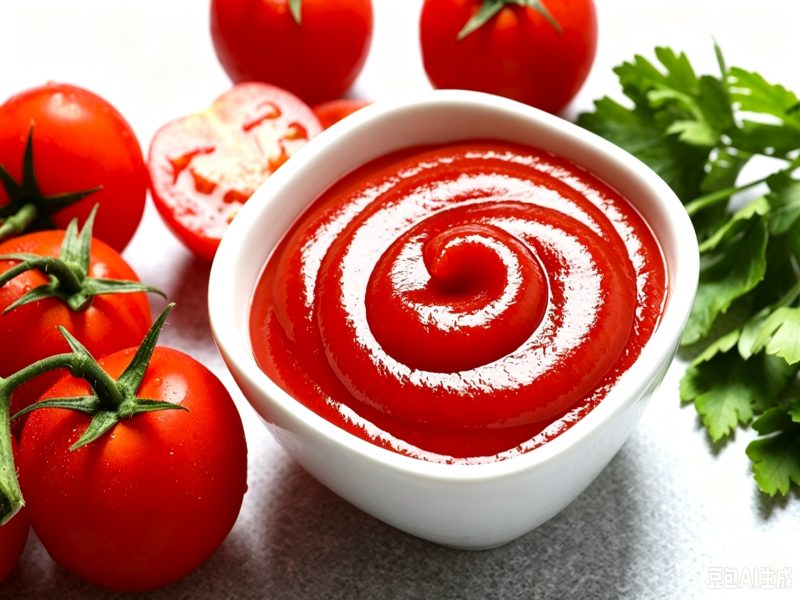
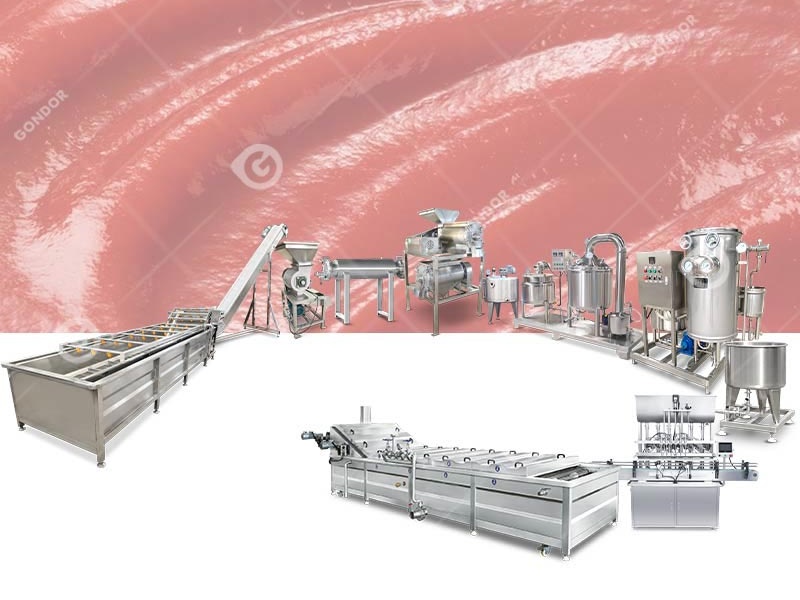
That gap between intuition and parameter-driven reality is what this guide walks through, from washing and sorting to concentrating, sterilizing, and aseptic filling — engineering details brochures tend to skip.
Step 1: Washing and Sorting — Quality Is Decided Before the Crusher
Even a rinsed tomato carries field soil, leaf fragments, and surface residue. A poorly sorted one carries rot and mold — and a single spoiled fruit can quietly drag down an entire batch’s color and flavor.
Industrial washing usually combines an air-bubble washer with high-pressure spray rinsing. Bubbles rising from the tank floor create a gentle rolling turbulence that lifts dirt away from the fruit surface without bruising it; the spray stage then gives each tomato a final rinse. As practical reference points, water temperature is typically held at 25–35 °C, spray pressure around 0.2–0.3 MPa, and residence time roughly 2–3 minutes. Too-hot water softens the skins prematurely, and overly aggressive pressure bruises soft-ripe fruit .
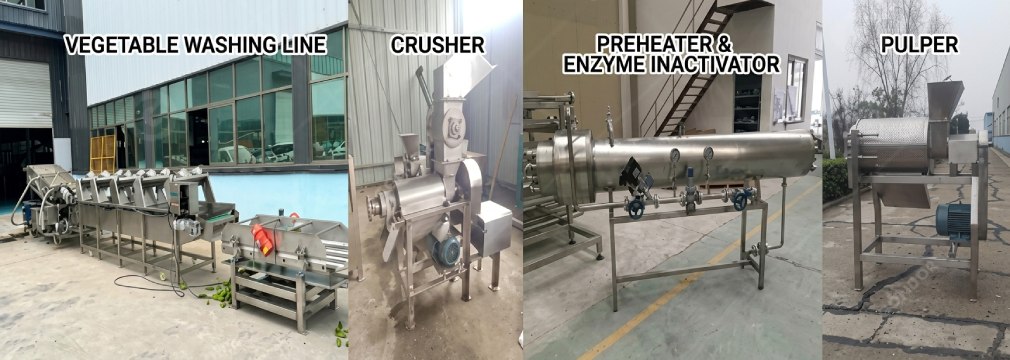
Sorting is the step people undervalue, and it deserves more respect. A roller-type fruit sorter rotates each tomato a full 360° as it travels down the belt, so no patch of skin stays hidden. Vision cameras — or experienced inspectors — scan every surface and physically eject undersized, sunburned, diseased, or pest-damaged fruit before it ever reaches the crusher. This is why industrial paste tastes clean and looks uniform: not luck, but deliberate removal.
Industry tip: Don’t wash and sort “by feel.” Keep the recirculated wash water at 2–5 ppm free chlorine and drain the flume on a fixed schedule — soil builds up faster than most operators expect, and dirty water re-contaminates the very fruit you’re trying to clean. Also size the sorter rollers against the minimum acceptable fruit diameter, not the average. Remember, concentration magnifies problems: a 2% defect rate at intake can become 10% of off-notes in the finished paste.
Step 2: Crushing and Pre-heating — Hot Break vs. Cold Break
Crushing bursts the tomato’s cell walls and releases the pulp, pectin, and native enzymes that shape everything downstream. How quickly the mash is heated after crushing determines which process route you’re on.
Hot break: the crushed mash is heated almost instantly to 85–95 °C, inactivating pectin-degrading enzymes (such as PME) within seconds. Pectin survives, so the finished product is thick and glossy — the classic ketchup and pizza-sauce body.
Cold break: the mash is held at 60–65 °C (or sent straight to the pulper), letting those same enzymes partially break pectin down. The result flows more freely and keeps a brighter, fresher tomato character — ideal for juices and premium sauces.
| Consideration | Hot Break | Cold Break |
|---|---|---|
| Pre-heat temperature | 85–95 °C, near-instant | 60–65 °C, or none |
| Finished viscosity | High, rich body | Lower, free-flowing |
| Color & flavor | Deeper red, cooked notes | Bright red, fresher taste |
| Best-fit products | Ketchup, pizza sauce, paste | Juice, light sauces |
| Investment | Medium | Medium-high (enzyme control) |
| Maintenance | Moderate | Higher (enzyme fouling) |
| Energy profile | High at the break stage | Lower there, higher later in evaporation |
Engineering note: Hot break lives or dies in the 5–10 seconds between crushing and reaching 85 °C. If the pre-heater is undersized or the steam supply wavers, the mash lingers in the enzyme window and your “hot-break” paste behaves like a cold-break one — thin, unwilling to thicken. When ketchup viscosity mysteriously drops, inspect this timing window before you reach for thickeners.
Step 3: Pulping and Refining — Separating the Good from the Peel
The heated mash moves into a pulping machine that strips out skins and seeds. Modern designs use a conical-screen double pulper: a coarse pass (around 1.0 mm) catches large skin pieces and seeds, and a fine pass (around 0.5 mm) refines the body into a silky, seed-free puree. The key upgrade over older machines is an adjustable rotor-to-screen clearance, which lets operators adapt to fruit texture without stopping the line to swap screens — a real productivity win during a short, intense tomato season.
Fresh pulp typically leaves the pulper at 4.5–5.5° Brix, ready for concentration.
Engineering note: The pulper’s worst enemy isn’t low yield — it’s crushed seeds. Broken seeds release bitter, green off-notes, and evaporation only concentrates them further. For firm late-season fruit, close the rotor gap slightly (on the order of 1 mm) to squeeze out extra juice; for soft, overripe lots, open it up so seeds pass through whole. Adjust by clearance, not by cranking the rotor speed.
Step 4: Vacuum Concentration and UHT Sterilization
Low-Temperature Vacuum Concentration
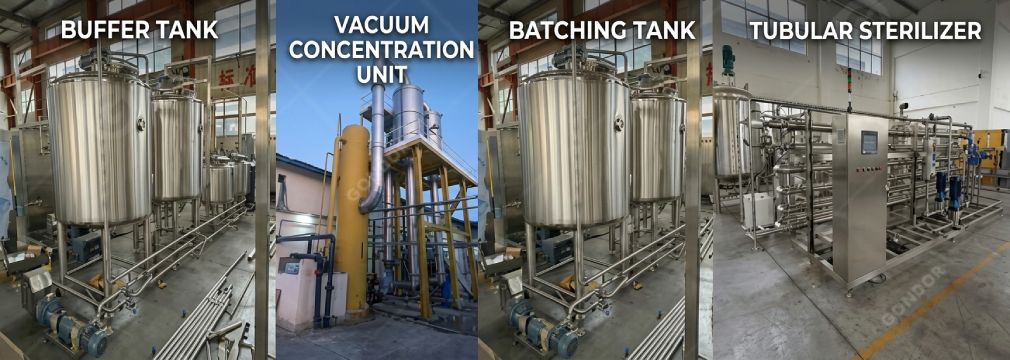
Going from roughly 5° Bx pulp to 28–38° Bx paste means removing a great deal of water — but never at atmospheric boiling, which would destroy lycopene and volatile aroma compounds. That’s why industrial lines use multi-effect vacuum evaporators, running at about -0.06 to -0.09 MPa so the product boils at just 60–70 °C. A well-designed double-effect system, such as the one on the Gondor tomato ketchup production line, keeps the first-effect temperature below 70 °C and the residence time short — both essential for preserving color and nutrition.
Reference figures worth keeping:
- Feed Brix: 4.5–5.5°
- Finished Brix: 28–38° (customer-configurable)
- First-effect temperature: < 70 °C
- Vacuum: roughly -0.06 to -0.09 MPa
- Feed-to-product ratio: about 6–8 t fresh tomatoes → 1 t of 28–30° Bx paste
- Energy design: double-effect structure plus condensate and secondary-vapor heat recovery for meaningfully lower steam consumption
Tubular UHT Sterilization
Concentrated or formulated product then passes through a tubular UHT sterilizer, typically at 125–135 °C for 15–30 seconds — enough to reach commercial sterility while keeping flavor loss minimal. Temperature and holding time are closed-loop controlled by the PLC, which is exactly why “absolute parameter stability” matters so much in practice.
Engineering note: Above roughly 95 °C, tomato pulp fouls heat-exchanger surfaces quickly, and burn-on ruins the batch’s taste. For a product with pulp particles, a tubular sterilizer is the safer choice over a plate one — wider channels, fewer blockages. And track the ΔT across the heating section: when it climbs 2–3 °C above your baseline, run CIP before the cooked flavor appears.
Step 5: Aseptic Filling and Packaging
The sterile concentrate is piped through a steam-sterilized aseptic filling head into large pre-sterilized containers — commonly 200–220 L aseptic bag-in-drum systems or 1,000 L IBC totes — with nitrogen purging of the headspace. For retail formats, bottle or pouch filling lines can be followed by a water-bath pasteurizer, whose precisely controlled temperature curve (a core temperature of roughly 85–95 °C for several minutes, depending on pack size) extends shelf life for long-distance shipping and export.
Thanks to aseptic filling, industrial tomato paste keeps for 18–24 months at ambient temperature — no refrigeration, no preservatives.
The One-Stop Answer: Gondor’s Smart Tomato Ketchup Production Line
Five steps, one roof, zero handoffs — that’s where the ROI of a turnkey line truly lands. The Gondor smart tomato processing system bundles them together with a few advantages that are hard to bolt onto an ad-hoc layout later:
- Full-line PLC automation.
One touchscreen governs temperature, flow, level, and Brix in real time, with hot-break and cold-break recipes switchable at the push of a button. Sterilization and concentration parameters stay rock-steady, shift after shift. - Energy-efficient evaporation.
Double-effect vacuum concentration combined with condensate and secondary-vapor heat recovery keeps steam and power consumption per tonne well below single-effect designs. - Modular, fast to deploy.
Standardized, skid-mounted equipment scales in clean steps — 1 t/h, 2 t/h, and beyond — with few wear parts and low downtime. - Multi-fruit flexibility.
The same line, with minor adjustments, processes apples, mangoes, berries, and other fruit for pulping — a lifeline for plants that run seasonal campaigns.
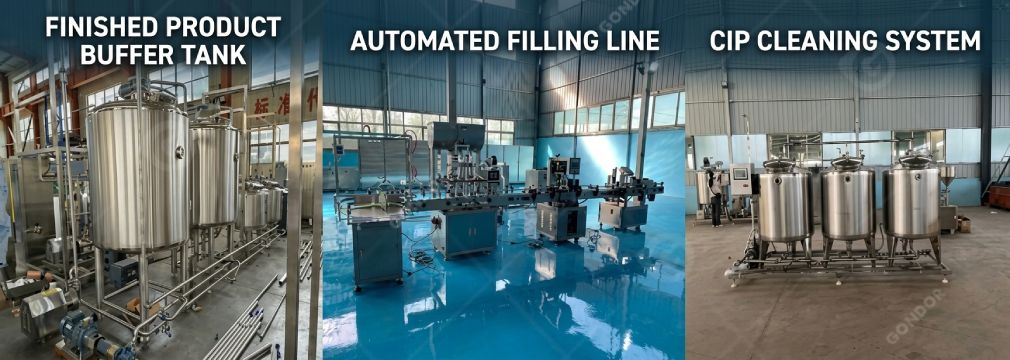
Add an integrated CIP system and optional IoT-based traceability (raw-material origin, process parameters, test results), and you have a platform built as much for food-safety audits as for output. All product-contact parts are SUS304 food-grade stainless steel.
If you’re evaluating a greenfield plant or an upgrade, I’d push you to quiz any supplier on three things before signing:
- Recipe changeover speed (is hot-break to cold-break a one-button job?)
- Evaporation heat-recovery rate (a good double-effect design should reclaim a large share of vapor and condensate heat)
- Full-line CIP coverage — on a hundred-tonne-per-day line, manual disassembly cleaning is simply not sustainable.
For layout drawings, configuration options, and real application cases, head over to the Gondor tomato ketchup production line product page — or simply tell us your daily tonnage and target Brix, and we’ll recommend a matching setup.