Industrial Green Banana Peeling Equipment Guide
In the global tropical fruit supply chain, green bananas serve as the foundational raw material for banana chips, banana flour, banana starch, and a growing range of health-focused food products. Yet the peeling stage has long remained a labor-intensive bottleneck — slow, costly, and inconsistent in both yield and hygiene. The green banana peeling machine exists to solve exactly this problem, transforming what was once a manual, time-consuming task into a stable, efficient, and fully standardized automated process.
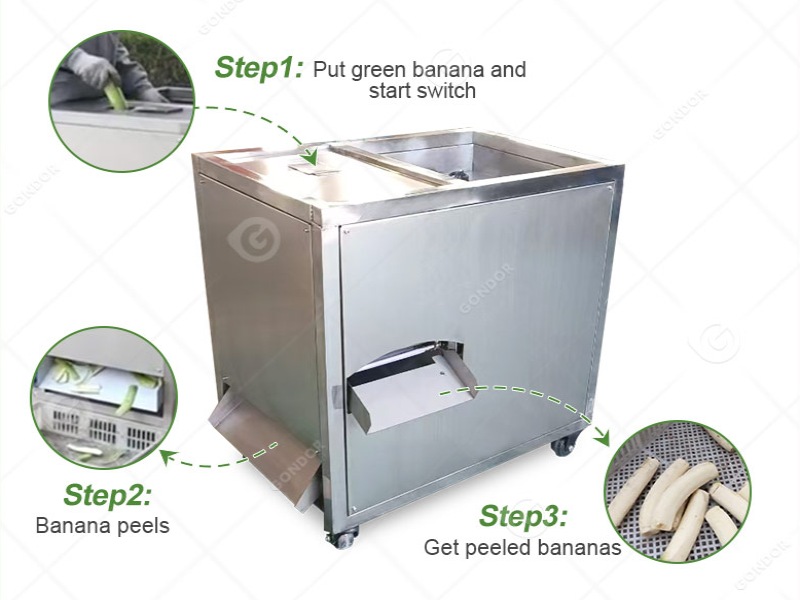
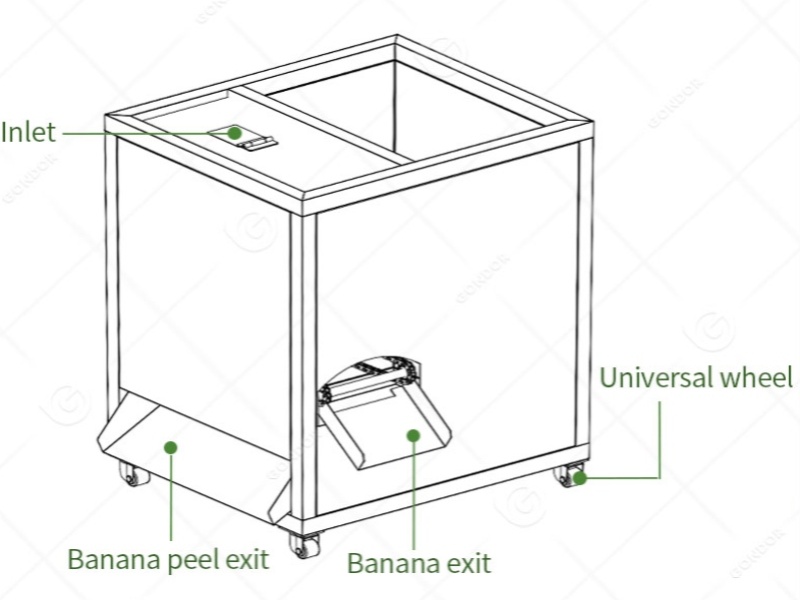
Unlike general-purpose fruit peeling equipment, this machine is engineered specifically around the physical characteristics of green bananas. Unripe bananas have tightly bonded skin and pulp, high starch content, and firm texture — conventional peeling methods routinely cause pulp damage or residual skin fragments. The GD-BAPM series addresses these challenges through precision mechanical design, achieving clean separation for green bananas of any curvature, size, or shape. The peeling efficiency reaches 99%, with fruit pulp integrity also at 99% — virtually eliminating raw material waste.
Whether you operate a banana deep-processing facility or supply peeled banana raw material to downstream clients, this equipment plays a pivotal role on your production line — turning “peeling” from a cost center into an efficiency engine.
How the Green Banana Peeling Machine Works
The entire workflow is built around one core principle: mechanically replicate the peeling motion of a human hand, but faster, more consistent, and cleaner. After an operator manually places green bananas into the feed port, the internal peeling mechanism handles everything that follows — no intermediate manual intervention required.
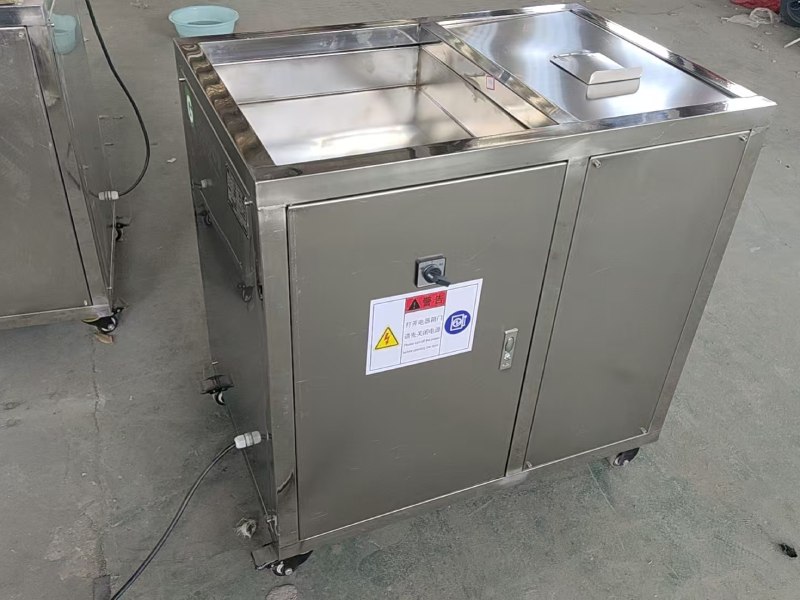
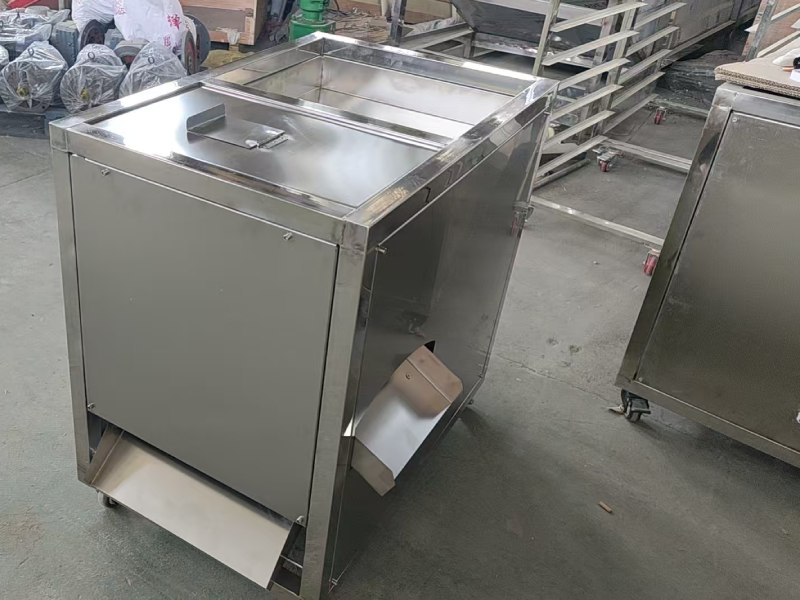
The standout design feature is the dual-channel discharge system: after peeling, intact pulp exits through the pulp outlet while skin is automatically expelled through a separate peel outlet. This split-stream design prevents cross-contamination — a critical advantage during continuous production where every banana must meet the same standard, regardless of operator fatigue or handling variations.
The core components are constructed from 304 food-grade stainless steel, fully compliant with international food processing hygiene standards. The feed port supports one-handed operation, and the discharge process is fully automatic. The operating threshold is remarkably low — new staff can be trained and productive within minutes.
Technical Specifications Overview
The GD-BAPM series offers five models spanning the full range from small-batch lab processing to large-scale factory production. A startup food workshop can begin with the 100 kg/h compact model — modest investment, but enough to validate product and market. When order volume grows, upgrading to the 200 kg/h or 300 kg/h model requires no change to the overall production line logic. All models share the same design language and operating method, meaning staff need no retraining. This “scalability” is uncommon in food machinery — it significantly reduces purchasing risk by letting you expand capacity based on actual order volume rather than betting everything on a single high-capacity unit upfront.
|
Technical Parameter |
||||
| Model | GD-BAPM-A150 | GD-BAPM-B250 | GD-BAPM-B500 | GD-BAPM-A300 |
| Size | 950*730*930mm | 1170*740*1050mm | 2420*1000*1050mm | 2100*1060*1040mm |
| Weight | 94kg | 120kg | 260kg | 230kg |
| Voltage | 380V | 380V | 380V | 380V |
| Power | 0.4KW | 0.4KW | 0.4KW | 0.74KW |
| Capability | 150kg/h | 220-260kg/h | 500kg/h | 300kg/h |
The GD-BAPM series includes five models, from compact to industrial-grade high capacity, covering every production scale. All models feature 304 stainless steel construction and support 220V/380V voltage configurations, adaptable to your target market’s electrical standards.
Notably, even the highest-capacity model draws only 0.74 kW of power — exceptionally low energy consumption. Compared to other fruit processing equipment of similar throughput, operating electricity costs are virtually negligible, which is especially beneficial for customers in regions with high electricity rates.
Where This Machine Creates Value
The applications of a green banana peeling machine extend far beyond simply “removing banana skins.” As the global health food market expands rapidly, green bananas are gaining prominence as a premium source of starch and dietary fiber — creating an entirely new set of deep-processing demands. Here are the most common application scenarios for this equipment today:
Geographically, the primary demand for this equipment is concentrated in India, the Philippines, Ecuador, Indonesia, Brazil, Colombia, and other major banana-producing nations. These regions share common characteristics: high banana output, rising labor costs, and food processing industries transitioning from primary to deep processing. For food enterprises in these markets, a reliable industrial-grade banana peeler is not just an efficiency tool — it’s the hardware foundation for product upgrading.
From Pain Point to Purchase Decision: Why Now Is the Right Time
- Manual Peeling Is Losing Its Economic ViabilityIn the past, banana-producing regions had abundant, low-cost labor — manual peeling was the obvious choice. But over the past five years, labor costs in major Southeast Asian and Latin American banana regions have risen 30%–50%, while skilled peeling workers are increasingly hard to recruit.The critical issue is that manual peeling has an unsolvable consistency problem — different workers use different techniques, and even the same person varies between morning and evening shifts. This causes product quality fluctuations downstream. In an industry that increasingly demands standardization and traceability, this variability is becoming a genuine business risk.
- The ROI Is Better Than Conventional Wisdom SuggestsMany food business owners hesitate on equipment investment, primarily concerned about “uncertain capacity needs” and “long payback periods.” But let’s run the numbers: using the mid-range GD-BAPM-A150 (150 kg/h capacity) as an example, at 8 hours per day, daily throughput reaches 1,200 kg.If this replaces 8 peeling workers (estimated at $300/month each), monthly labor savings reach approximately $2,400 — the equipment pays for itself in under two months. This doesn’t even account for the hidden savings from improved raw material utilization: the 99% peeling rate versus manual’s 92%–95% means dozens of additional kilograms of usable pulp per day, which compounds into a meaningful figure over time.
- Brand Value and Customer Trust — The Hidden AdvantageIncreasingly, international food buyers evaluate supplier equipment levels as part of their assessment criteria. Having standardized, automated peeling processes means your product quality is backed by equipment — not dependent on individual worker skill.In B2B transactions, this “hardware-backed assurance” is often more persuasive than verbal commitments. When exporting to European or American markets, ISO, CE, and BSCI certifications combined with automated equipment configuration give buyers significantly greater confidence in your factory’s capabilities.
Recommended Complementary Equipment
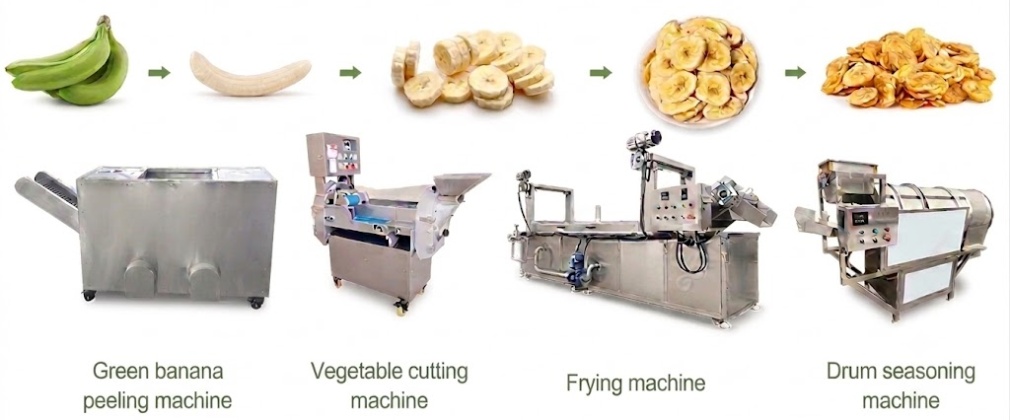
The green banana peeler typically serves as the first stage of a production line. Combined with the following equipment, it forms a complete banana deep-processing system: